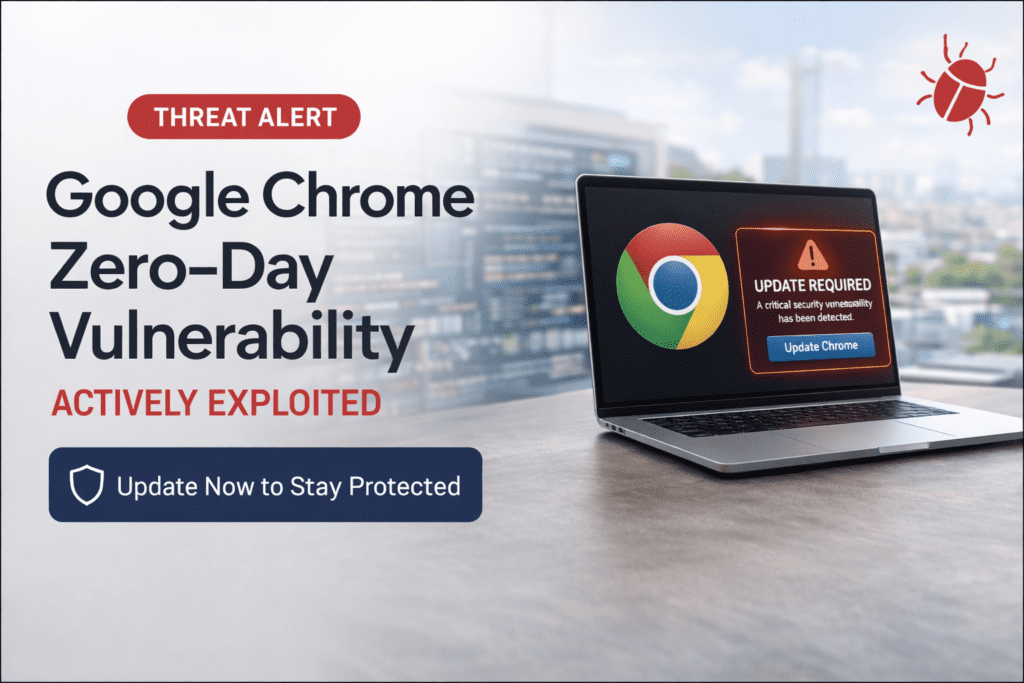
Google Chrome Zero-Day Vulnerability Actively Exploited – Update Immediately
Overview
A critical zero-day vulnerability has been discovered in Google Chrome, and attackers are already exploiting it in real-world attacks.
Unlike typical vulnerabilities, zero-days are especially dangerous because no prior patch exists at the time of exploitation, giving attackers a significant advantage.
Technical Breakdown
The vulnerability allows remote code execution (RCE), meaning an attacker can execute malicious code on a victim’s system simply by getting them to visit a compromised or malicious website.
Attack vectors include:
- Malicious websites
- Drive-by downloads
- Compromised advertisements (malvertising)
Once exploited, attackers can:
- Install malware
- Steal browser-stored credentials
- Hijack active sessions
Real-World Impact
This isn’t theoretical — exploitation has already been observed in the wild.
For enterprises, this could mean:
- Unauthorized access to internal systems
- Data exfiltration
- Lateral movement across networks
Immediate Mitigation Steps
If you ignore this, you’re asking to get compromised.
Do this now:
- Update Chrome via: Settings → About → Update
- Restart browser after update
- Enable automatic updates
- Use endpoint protection solutions
Expert Insight
Modern attacks are shifting toward browser-based exploitation, because browsers are now the gateway to SaaS, cloud apps, and sensitive data.
Why This Matters
With increasing reliance on web applications, a compromised browser can act as a single point of failure for your entire digital identity.
Tags:
Zero-Day, Google Chrome, Vulnerability, Cybersecurity